Public engineering case study
A secure operations platform for a national nature writing competition.
Built for the Scottish Wildlife Trust to manage multilingual submissions, volunteer reader allocation, scoring, arbitration and final competition rankings.
Privacy note:
All interface images shown on this site use representative
demonstration data. No live submission content, volunteer details,
credentials or private operational records are displayed.
The operational challenge
Replacing a complex manual process with one connected system.
The competition required hundreds of anonymous submissions to be distributed across a large volunteer reading team, with every story reviewed independently and routed correctly across English, Scots and Gaelic.
Anonymous processing
Submission data is transformed into anonymous PDFs and reader materials without exposing entrant details.
Language-aware allocation
The allocation engine prioritises Scots and Gaelic capability before distributing English-language entries.
Automated reconciliation
Prefilled review links connect every response to the correct reader, story and assignment automatically.
System architecture
Google Workspace automation with a secure Next.js control layer.
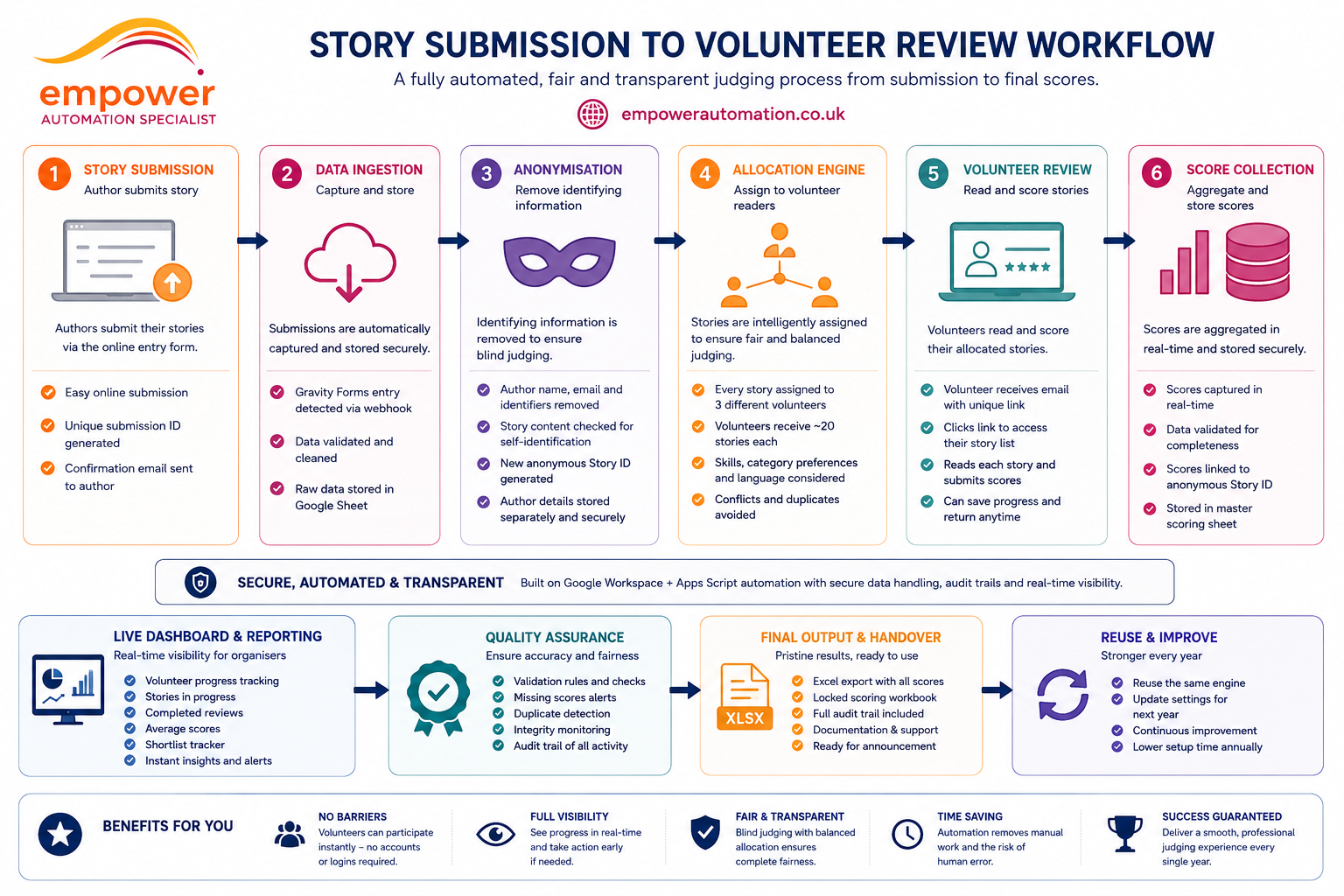
Google Apps Script manages the background workflow, while the server-side dashboard gives authorised administrators a clear, responsive operational interface.
Submission intake
Gravity Forms sends new entries into the operational Google Sheets database through a webhook-driven workflow.
Automation engine
Apps Script creates anonymous PDFs, allocates readers, assembles packs and sends personalised reviewer emails.
Review reconciliation
Prefilled Google Forms preserve assignment identifiers and reconcile each response with the correct story.
Operations dashboard
A secure Next.js application provides live progress, adjudication, allocation and competition insights.
Next.js
TypeScript
Google Apps Script
Google Sheets API
Microsoft Entra ID
Tailwind CSS
Visual product tour
Live operational oversight without opening the underlying database.
Each interface was designed to help staff understand the current state of the competition quickly, identify risk early and act without manually auditing hundreds of spreadsheet rows.
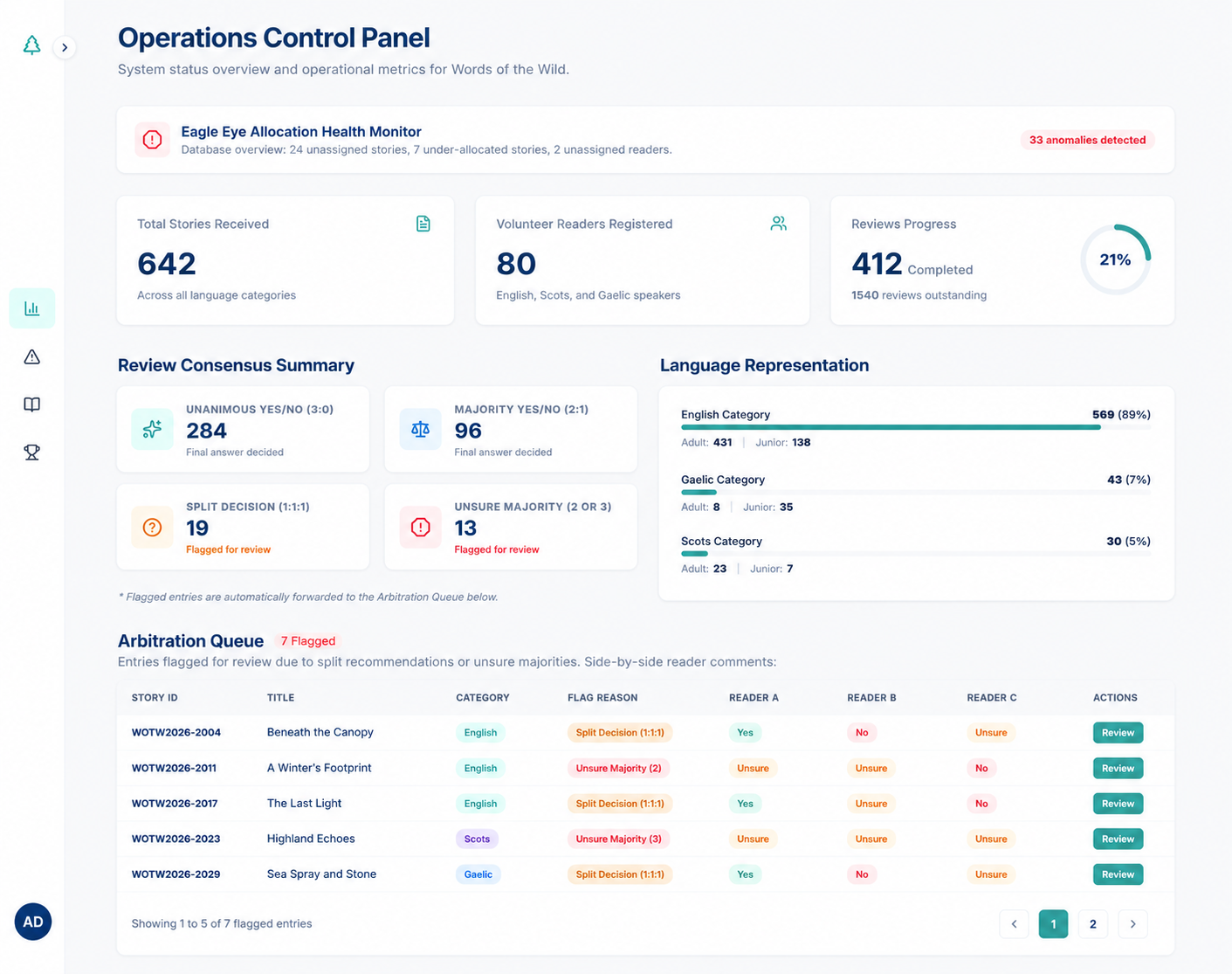
01 · Operations control panel
One place to understand the entire competition.
The main dashboard combines submission totals, completed reviews, language representation, consensus outcomes and the arbitration queue.
- Live progress indicators
- Consensus and review summaries
- Language distribution monitoring
- Arbitration cases requiring staff action
02 · Stories adjudication monitor
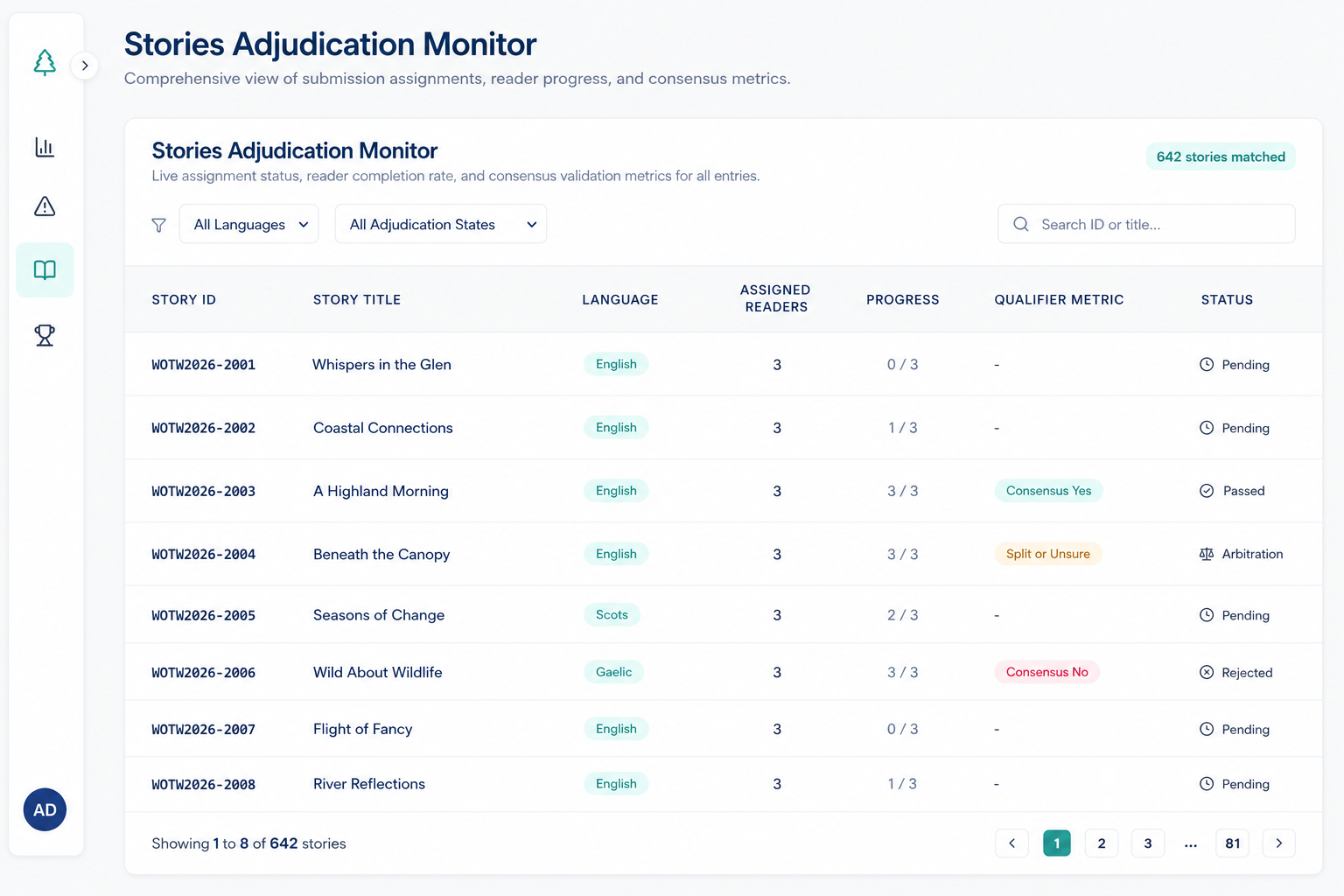
Story-level progress across hundreds of submissions.
Every anonymous submission can be searched, filtered and reviewed without exposing entrant information.
- Allocated-reader counts
- Completed review progress
- Exact Yes, No and Unsure ratios
- Language and adjudication filters
- Pagination designed for 650+ entries
03 · Eagle Eye allocation health
A proactive integrity check for the operational database.
Eagle Eye identifies allocation problems before they become competition delays.
- Unassigned stories
- Under-allocated stories
- Readers with no assignments
- Collapsible anomaly details
- Early warning of operational gaps
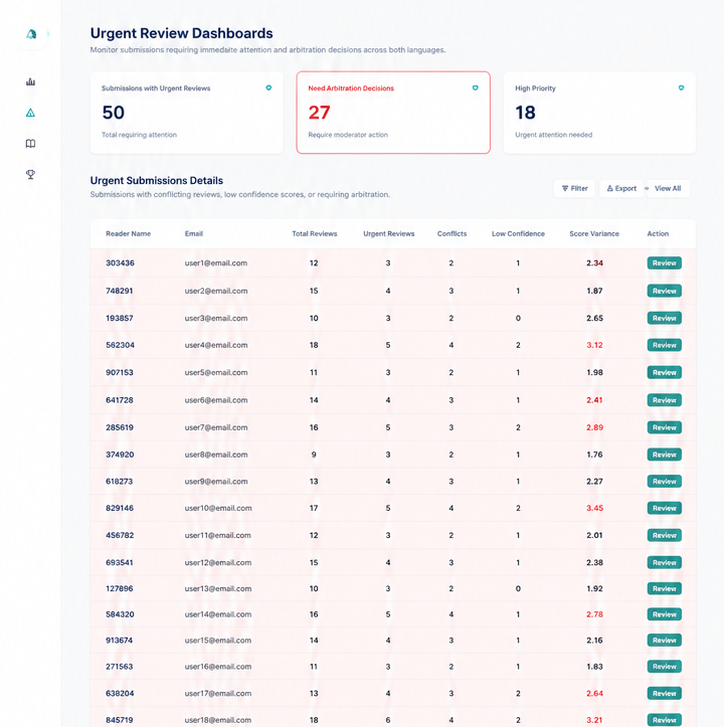
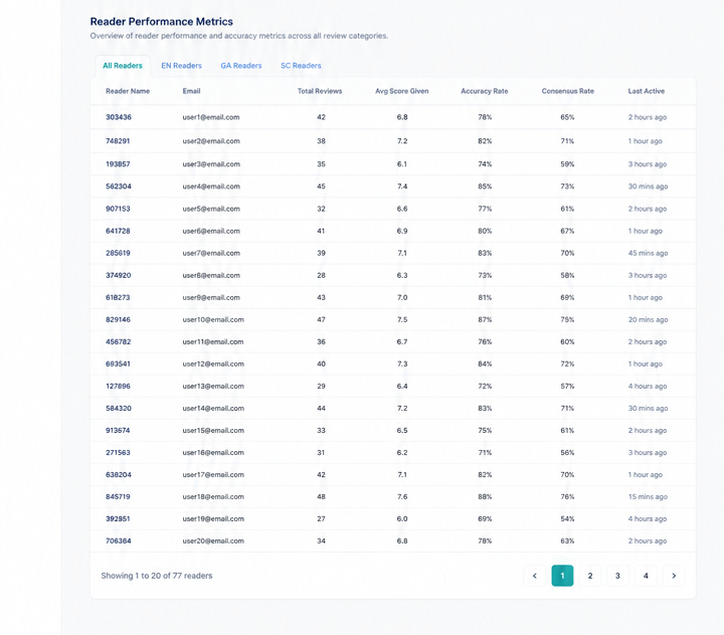
04 · Reader review matrix
Performance, alignment and review activity at a glance.
Anonymous reader identifiers allow staff to monitor completion, average scoring and consensus alignment without displaying public volunteer information.
- Completed review totals
- Average score analysis
- Consensus alignment
- Recent reviewer activity
- Strict, balanced and lenient calibration
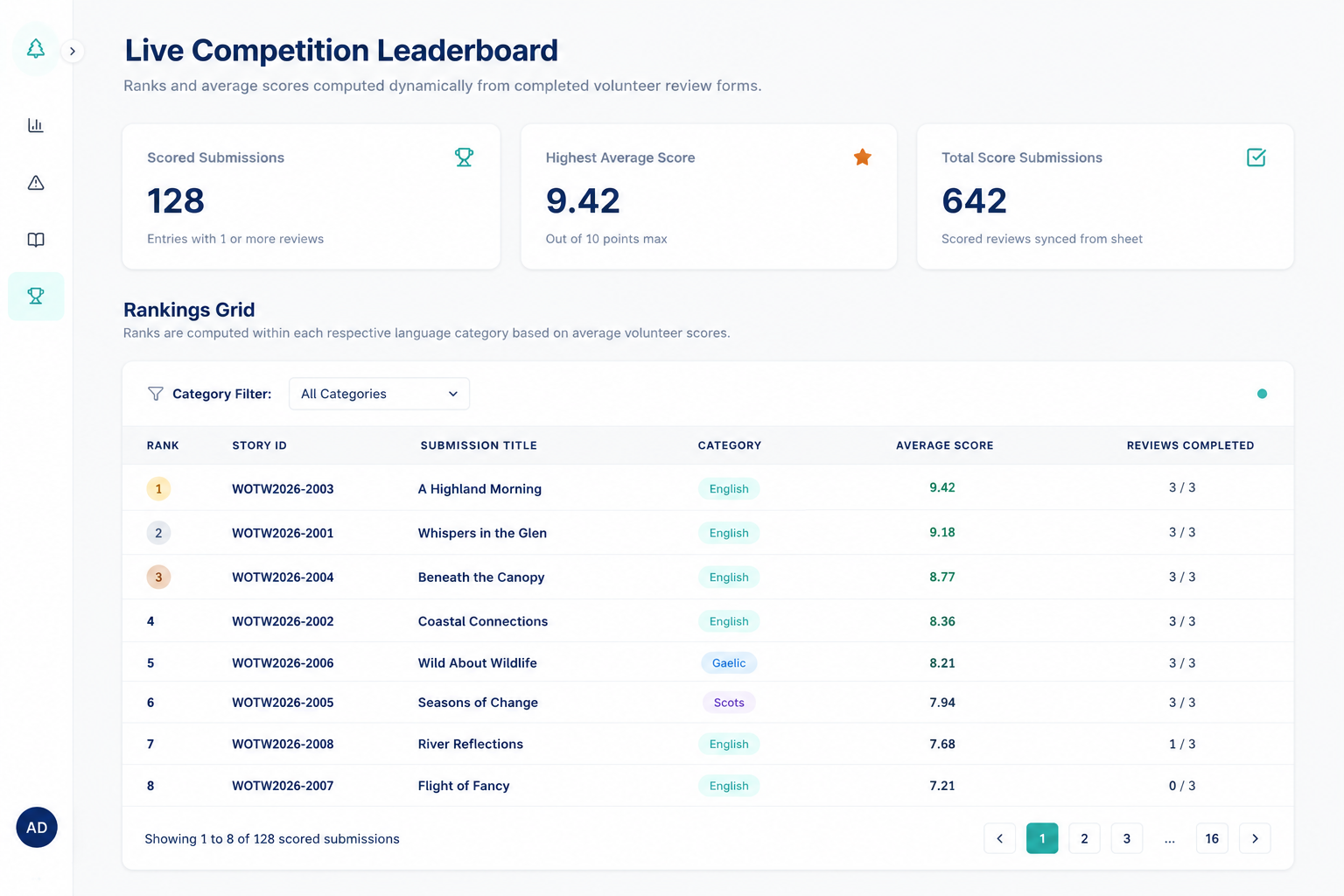
05 · Competition leaderboard
Live rankings generated from completed score forms.
Rankings are calculated within the correct competition category and language stream.
- Anonymous Story IDs
- Average scores
- Completed review counts
- Language-specific filtering
- Current ranking position
Enterprise security model
Protected at identity, domain and data-access level.
The public-facing case study contains no production source code or private operational data. The live system applies layered access controls before any dashboard content is rendered.
Microsoft Entra ID
Authentication is restricted to the Scottish Wildlife Trust's dedicated Microsoft tenant.
Corporate domain validation
A second server-side check ensures only authorised organisational email addresses are accepted.
Server-side data access
Operational data is retrieved securely without exposing database credentials to the browser.
Data minimisation
Story and reader workflows use anonymous identifiers wherever personal details are not operationally required.
Impact and outcomes
From spreadsheet coordination to proactive competition operations.
Manual work reduced
Reader allocation, document generation, pack assembly and notification emails are handled automatically.
Volunteer experience improved
Prefilled review links removed the need to search through a dropdown containing more than 1,000 story titles.
Earlier intervention
Staff can identify inactive readers, stalled stories and allocation gaps while the reading period is still active.
Transparent adjudication
Every story can be followed from assignment through vote ratio, consensus decision and arbitration.
Engineering principle
Client-owned infrastructure, not unnecessary SaaS dependency.
The system was designed around tools already present within the client's operational environment. Google Workspace handles the automation and data workflow, while the bespoke dashboard provides the specialist interface the competition required.
Explore the engineering case study